


Rethinking Jewelry: Redesigning Pieces for Accessibility

Jewelry is usually designed with a familiar set of assumptions: a necklace fastens behind the neck, a bracelet closes around the wrist, and earrings use small backs or clasps. For many people, those designs work perfectly well. For others, the smallest part of a piece—the clasp, backing, or closure—can be the most difficult part to use.
Limited dexterity, reduced grip strength, tremors, joint stiffness, or changes in hand mobility can make fastening jewelry frustrating or uncomfortable. Research and writing on accessible jewelry increasingly points to a simple idea: jewelry can be designed around the person wearing it, rather than expecting every wearer to adapt to the same traditional construction.
That does not necessarily mean buying entirely new jewelry.
Sometimes a relatively small alteration can make an existing piece easier to wear. Other times, a redesign can give a sentimental piece an entirely new form while preserving the stones, metal, or meaning behind it.

The Clasp Can Change Everything
“Have you ever picked up a favorite bracelet you've popped on for years and now you can't clasp it? Traditional clasps can be difficult to use. Many Watches and bracelets use spring rings on lobster claws. They are small by design to blend in but require precise finger movements to operate. We have solutions here to help.
First, we can provide larger springs, spring rings, or lobster clasps. Other alternatives include magnetic clasps, sport clasps, and my personal favorite, the toggle clasp, which, besides being easy to use, provides more options for ways to accent your necklace. Like leaving it in front and hanging a pendant from it. Earrings can also be adjusted. We love the jumbo nuts for posts, lever backs that just open and click shut for everyone.
No single solution works for everyone. Your best option is a visit to From the Vault Jewelers where we can assess your mobility issues and provide the best solution for your needs.” - Sheila Newton
The best choice is not necessarily the most technically complicated one. It is the one that makes sense for the person who will actually be wearing the jewelry.
A Bracelet Does Not Have to Be a Bracelet with a Clasp

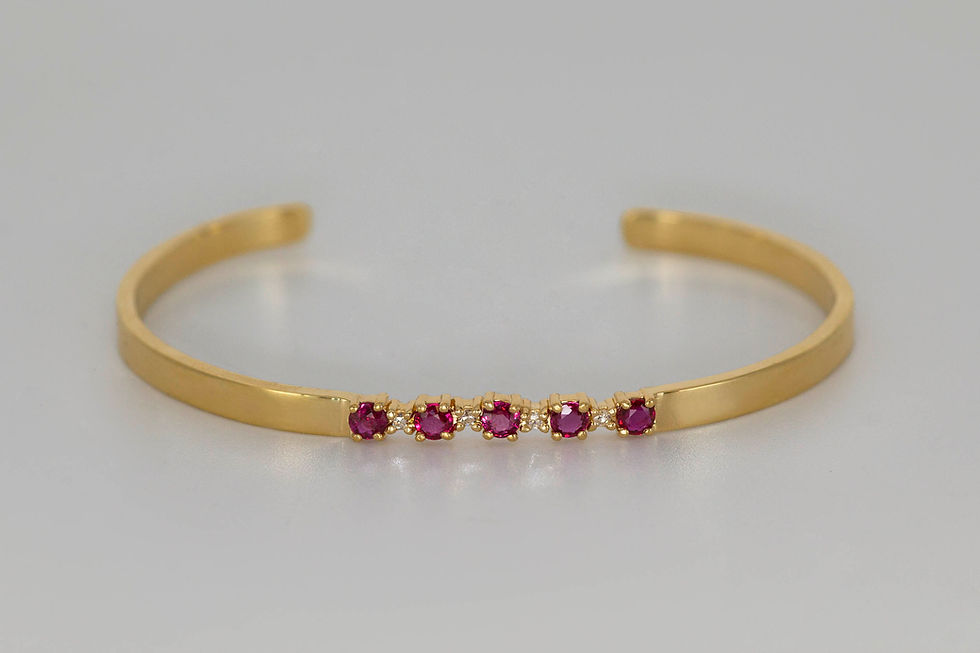
Bracelets are particularly interesting when considering accessibility because putting one on often requires two hands.
One hand has to hold the bracelet in place while the other operates the clasp. For someone with limited dexterity or grip strength, that simple process can become surprisingly difficult.
A cuff bracelet offers another possibility.
Instead of fastening a small clasp around the wrist, a cuff can be designed to open or slip into place around the wrist. Depending on the design and the materials involved, a traditional bracelet may be able to be redesigned into a cuff or another style that is easier for the wearer to manage.
This can also be an opportunity to preserve an existing piece of jewelry. Stones or metal from a sentimental bracelet may potentially be incorporated into a new design, giving the original materials a new purpose instead of leaving them unworn.
Necklaces Can Be Rethought
The clasp on a necklace can present the same problem as a bracelet, particularly because it is usually positioned behind the neck where it is difficult to see or reach.
One possible solution is an alternative closure that is easier to grasp. Another is changing the length or construction of the necklace so that it can be put on without manipulating a small clasp.

Adjustable necklaces can also provide flexibility when comfort, layering, or changes in fit are considerations. Accessible jewelry resources commonly recommend adjustable lengths and closures that require less precision than traditional small clasps.
In some cases, a completely different piece may be the better solution. A ring that is no longer comfortable or practical to wear on the finger, for example, may be able to become part of a necklace or another piece of jewelry while preserving its original stones or metal.
Earrings Can Be Modified, Too
Earrings are another place where a very small component can have a large effect on usability.
Traditional butterfly backs are tiny and require precise movements to position correctly.

Depending on the wearer and the type of earring, alternative mechanisms such as lever backs, screw-backs, or other larger closures may be easier to handle. Accessible-jewelry resources identify these types of alternatives as possibilities for people who have difficulty with fine finger movements.
The weight of an earring can also matter. Lightweight jewelry may be more comfortable for someone who finds heavier pieces tiring or uncomfortable. Consider the weight and balance of a piece rather than looking only at its appearance.
Accessible Jewelry Does Not Mean Giving Up Style
There can be an assumption that accessible jewelry has to look clinical, oversized, or obviously different from other jewelry.
It does not.
A larger clasp can still be incorporated into an elegant design. A cuff can be sculptural and intentional. An adjustable necklace can be delicate and refined. A different earring closure can be almost invisible once the piece is being worn.
The goal is not simply to make jewelry easier to operate. It is to make it easier to operate while still making it feel like the wearer's jewelry. Accessibility should be integrated into design rather than treated as a reason to sacrifice beauty or self-expression.
Redesigning Jewelry Around the Person

There is no single version of accessible jewelry because there is no single experience of limited mobility or dexterity.
One person may need a larger clasp. Another may find a toggle easier. Someone else may prefer a cuff because they want to avoid fastening a bracelet altogether. A different wearer may need a lighter piece, a longer chain, or a completely different way of wearing an existing item.
That is where jewelry redesign can become especially useful.
Instead of beginning with a standard piece and asking the wearer to work around it, a jeweler can begin by asking what is difficult about the jewelry as it currently exists.
Is the clasp too small?
Is the bracelet difficult to hold in place?
Is the piece too heavy?
Is the wearer unable to reach the closure?
Would a different mechanism make it easier?
Could the existing stones or metal be used in another design?
These questions can turn an unworn piece into something practical again.
Jewelry Can Adapt as We Do
Accessibility is not only about disability. Our ability to handle jewelry can change throughout our lives. Aging hands may experience changes in grip strength, dexterity, joint movement, or comfort, and these changes can affect everyday activities such as fastening a bracelet or putting on an earring.
A piece of jewelry that was easy to wear ten or twenty years ago may not feel the same today. That does not necessarily mean the jewelry has reached the end of its life.
Changing a clasp, modifying a bracelet, adjusting a necklace, or redesigning a sentimental piece can allow jewelry to change along with its wearer.
The Best Jewelry Is Jewelry You Can Actually Wear
Jewelry can hold financial value, but its personal value often comes from being worn. It can mark a relationship, represent a family history, commemorate an important moment, or simply be part of how someone expresses themselves.

If a piece has become difficult to put on or take off, it can be easy to assume that the only solution is to stop wearing it.
Redesign offers another possibility.
A different clasp. An easier closure. A cuff instead of a clasped bracelet. A lighter design. An adjustable chain. A new setting. Or, sometimes, an entirely new piece made from the materials of the original.
Accessibility does not have to be an afterthought, and it does not have to come at the expense of beautiful design. Thoughtful jewelry design can consider both how a piece looks and how it actually functions for the person wearing it.
At From the Vault Jewelers, custom jewelry and redesign give us the opportunity to look at an existing piece and consider what else it could become. If you have jewelry that you love but find difficult to fasten, handle, or wear comfortably, bring it in and let us explore what may be possible.


Comments